Napoleon Cake – Russian Layered Custard Cake
Ingredients:
Preparation mode:
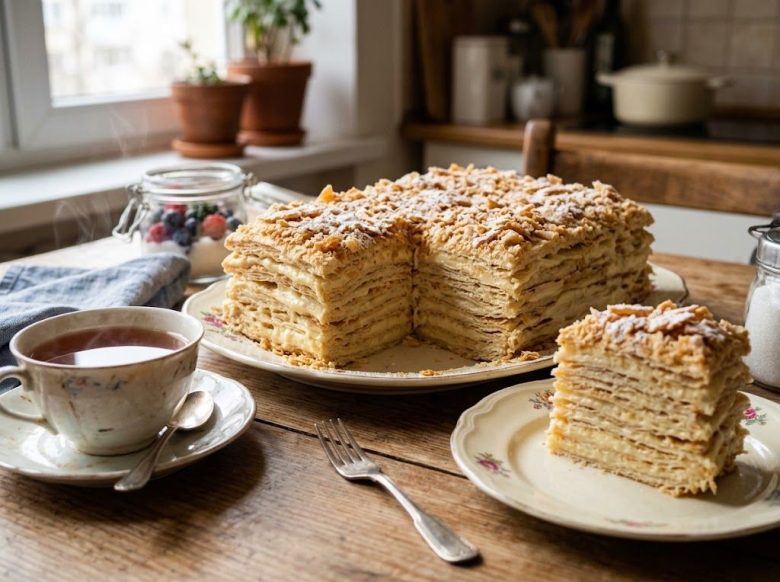
👉 Napoleon is the Russian version of the French mille-feuille and one of the most popular cakes on New Year and birthday tables across the former Soviet Union. Eight or more crisp, flaky pastry layers are stacked with silky vanilla custard and left overnight until the cake becomes soft and creamy, then covered in pastry crumbs. A popular story says it was first served in Moscow in 1912, for the 100th anniversary of Russia’s victory over Napoleon, cut into triangles like the emperor’s famous hat.
How to Make Napoleon Cake
- Make the pastry. Mix the flour and salt in a large bowl and rub in the grated cold butter until it looks like coarse crumbs. Whisk the egg with the cold water and vinegar, pour it in and bring the dough together quickly – do not knead. Divide into 8 equal balls, wrap and chill for at least 1 hour.
- Cook the custard. Heat 800 ml of the milk with half the sugar. Whisk the eggs with the rest of the sugar, the cornstarch and the remaining 200 ml cold milk. Pour a little hot milk into the egg mixture, whisk, then pour everything back into the pan. Cook over medium heat, whisking all the time, until thick and bubbling, 3–5 minutes. Stir in the vanilla, cover the surface with cling film and cool completely.
- Roll and bake the layers. Heat the oven to 200°C (400°F). Roll one ball very thin on baking paper, about 2 mm, and cut a 24 cm circle using a plate, keeping the scraps. Prick all over with a fork and bake for 7–9 minutes until golden. Repeat with all the balls and bake the scraps too.
- Finish the custard. Beat the soft butter until fluffy, then beat in the cold custard one spoonful at a time until smooth and creamy.
- Assemble. Place one layer on a serving plate and spread with custard. Repeat with all the layers, pressing gently, then cover the top and sides with the rest of the custard.
- Add the crumbs. Crush the baked scraps into fine crumbs and press them all over the top and sides.
- Rest. Cover and refrigerate for at least 8 hours or overnight before slicing.
Tips for the Best Napoleon Cake
- Keep the butter and dough cold – this creates the flaky layers.
- Bake the layers until properly golden; pale layers taste raw and become soggy.
- The custard must be completely cold before you beat it into the butter, or it will separate.
FAQ
What is the difference between Napoleon and mille-feuille?
A French mille-feuille has three crisp layers and is eaten fresh; the Russian Napoleon has many more layers and is rested overnight so it becomes soft and cake-like.
Why is it called Napoleon?
The best-known story links it to the 1912 celebrations of the victory over Napoleon in 1812, but similar French pastries were also called “napoléon” much earlier.
Can I make Napoleon cake in advance?
Yes – it is best made a day ahead and keeps 3–4 days in the fridge.
👉 More Russian holiday desserts: medovik honey cake, plus Olivier salad for the New Year table.
Ask the Chef:
Missing an ingredient or cooking for a crowd? Ask anything about this Napoleon Cake recipe.
AI cooking assistant. Answers can be wrong — always check allergens yourself.
Footnotes:
Resting is essential: the cake needs at least 8 hours, ideally overnight, in the fridge so the crisp layers soften into the custard.
Shortcut: use 2 packs (about 1 kg) of ready-made all-butter puff pastry, rolled thin and baked in 8 circles.